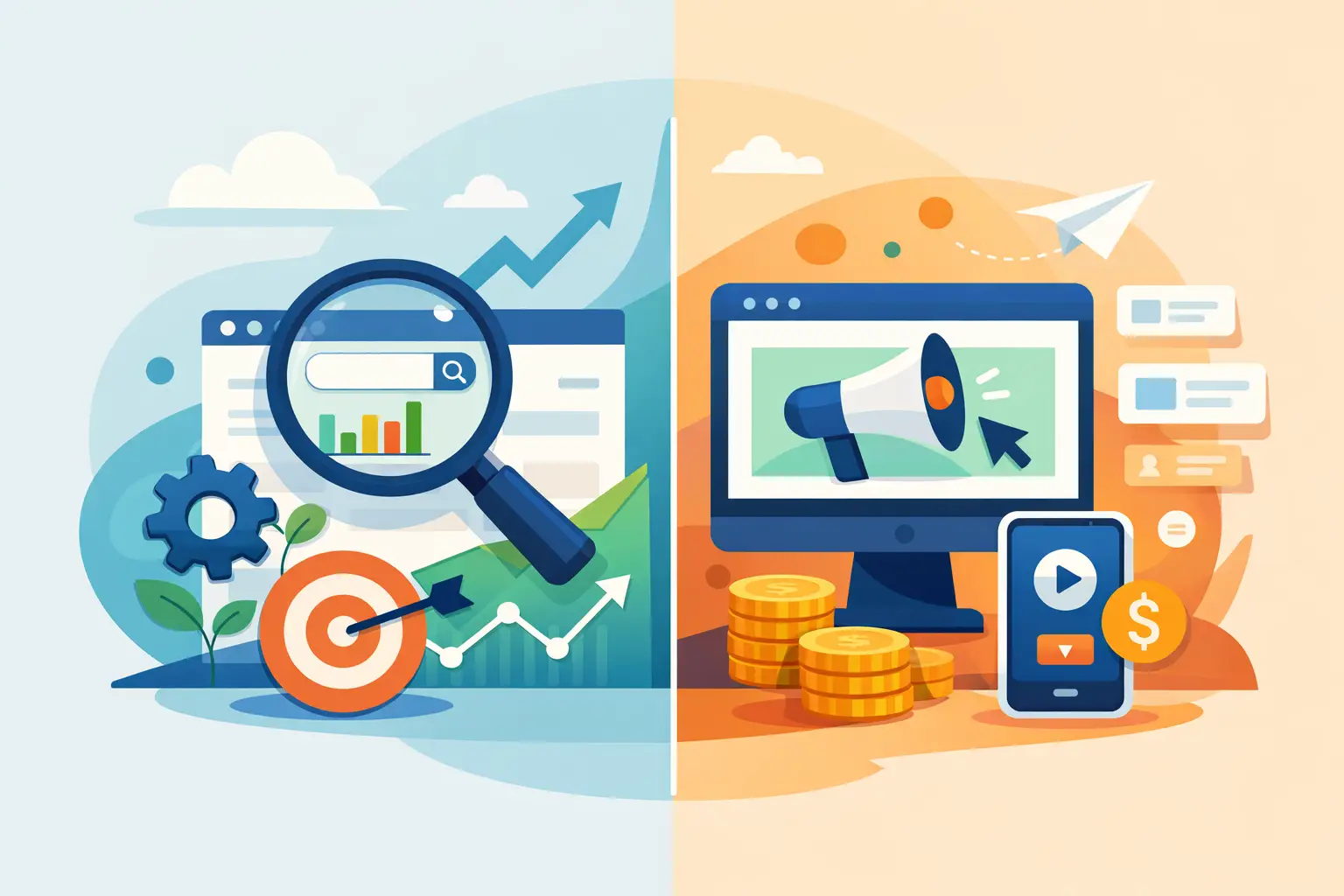
When a small business owner asks whether to invest in seo or google ads, they are usually not asking a theory question. They are asking because money is tight, time is limited, and the wrong choice feels expensive. If that sounds familiar, the good news is this: there is no one-size-fits-all answer, but there is a clear way to make the decision.
For most small businesses, the real question is not which channel is better in general. It is which one solves your next business problem. Do you need leads this month? Do you need long-term visibility in your local market? Do you already have a website that can convert traffic, or are you sending visitors to a site that creates more confusion than confidence? Those details matter more than any blanket advice.
SEO or Google Ads: What is the difference?
SEO helps your business show up in unpaid search results over time. That includes your website pages, service pages, blog content, and often your local presence through maps and business listings. You are building visibility that can continue working even when you are not actively paying for each click.
Google Ads is paid placement in search results. You choose keywords, write ads, set a budget, and pay when someone clicks. It can put your business in front of people quickly, which is why it often feels like the obvious answer when you need leads now.
Both can work. Both can waste money. The difference usually comes down to timing, competition, budget, and whether your business has the systems in place to turn attention into actual revenue.
When SEO makes more sense
SEO is often the better fit when you want steady growth and you are willing to build it with intention. If your business depends on local trust, repeat visibility, and being found consistently by people searching for your services, SEO can become one of your strongest long-term assets.
Think about a family law attorney, a med spa, a roofing company, or a bookkeeping firm. These are services people search for when they need them, and they often compare a few businesses before reaching out. If your website is well structured, your local presence is accurate, and your content clearly explains what you do and where you do it, SEO can help you show up again and again for the right searches.
The trade-off is speed. SEO usually does not deliver overnight results. It takes time to improve rankings, build authority, strengthen your local signals, and learn what content actually brings qualified traffic. For a business owner already feeling pressure, that timeline can feel frustrating.
Still, the long-term value is hard to ignore. A strong SEO foundation can lower your dependence on paid traffic. It can also improve the quality of your marketing overall, because good SEO usually forces you to clarify your services, improve your website, and create a better experience for the customer.
When Google Ads makes more sense
Google Ads is often the better choice when speed matters. If you need to generate traffic quickly, test service demand, or get in front of high-intent searchers in a competitive market, paid ads can help you do that faster than SEO.
That said, fast traffic is not the same thing as profitable traffic. Ads can drive clicks within days, but if your landing page is weak, your offer is unclear, or your follow-up process is inconsistent, the ad spend will expose those gaps quickly. This is one reason some business owners think ads do not work when the deeper issue is that the full sales path is not ready.
Google Ads can also get expensive in industries where every competitor is bidding aggressively. Legal services, home services, healthcare, and financial services can all have high costs per click. For a small business with a modest budget, that means every wasted click hurts more.
On the other hand, if your average customer value is strong and you know how to convert leads well, ads can be a very practical growth tool. They are also useful when you want cleaner testing. You can learn which services, offers, and search terms create action before spending months building organic content around the wrong assumptions.
SEO or Google Ads for a local small business
For local businesses, this decision often depends on how people buy in your market. If customers search with urgency, such as “emergency plumber” or “same-day appliance repair,” Google Ads can be powerful because the need is immediate. The person searching may call the first credible business they see.
If the buying decision involves more trust and comparison, SEO often carries more weight. A person looking for a wedding photographer, therapist, pediatric dentist, or business consultant may spend time reading reviews, exploring service pages, and checking your credibility before reaching out. In those cases, your website and local search presence do a lot of the heavy lifting.
Local SEO has another advantage for community-based businesses. It supports visibility not just in traditional website rankings but also in map results, branded searches, and service-area searches. That matters because many buyers want a nearby business they can trust, not just the first ad in the search results.
Budget changes the right answer
A lot of advice about seo or google ads skips over the budget issue, which is exactly what small business owners need addressed most. If your monthly budget is limited, you cannot afford a strategy that looks good on paper but fails in execution.
With SEO, the investment usually goes into site improvements, content, technical cleanup, local optimization, and ongoing strategy. You are not paying for each visitor, but you are paying for the work required to become more visible. The return often takes longer, but it can compound.
With Google Ads, the spend is more direct. You pay for traffic now. That makes the results more immediate, but once the budget stops, the visibility often stops too. For some businesses, that is fine. For others, it creates a treadmill they do not want to stay on.
If your budget is under $2,000 per month, trying to do aggressive SEO and aggressive Google Ads at the same time can spread you too thin. In that situation, it is usually smarter to choose a primary focus and make sure the basics are solid. A clean website, clear service pages, accurate tracking, and a well-managed Google Business Profile often do more for a small business than chasing every channel at once.
The best answer is sometimes both, but not equally
There are cases where using both channels is the smartest move. Google Ads can create short-term lead flow while SEO builds long-term stability. This approach works especially well when a business has clear priorities and realistic expectations.
But using both does not mean splitting time and money evenly. It may mean running a tightly controlled ad campaign for one high-value service while investing in local SEO and foundational website improvements. It may mean using ads during a seasonal push while continuing to strengthen organic visibility in the background.
This is where strategy matters more than tactics. Brown Business Group often sees small businesses get overwhelmed because they are told to do everything at once. Most do not need more marketing activities. They need a plan that matches the way their customers actually search, decide, and buy.
Questions to ask before you choose
Before spending another dollar, ask a few practical questions. How quickly do you need results? What is one new customer worth to your business? Are people already searching for your services in your area? Can your website turn interest into action? Do you have call tracking, form tracking, and enough visibility into your numbers to know what is working?
If you need quick traction and have a strong sales process, Google Ads may be the better immediate move. If you want durable visibility and your business depends on trust, SEO may be the better investment. If your foundation is weak, the smartest first step may not be either one. It may be fixing the website, local listings, messaging, and measurement so either channel has a fair chance to perform.
A lot of founders feel pressure to pick the perfect marketing channel. In reality, progress usually comes from making the next right decision, then building from there. The right strategy should reduce confusion, not add to it. If your marketing feels complicated, that is often a sign the plan needs to be simplified, not scaled.
The goal is not to win at search marketing in some abstract way. The goal is to help the right customers find you, trust you, and take the next step with confidence. Start there, and the choice becomes a lot clearer.