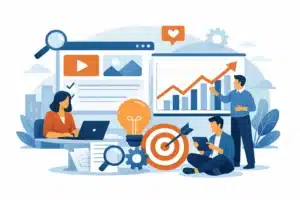
Most small business owners do not have a growth problem. They have a focus problem.
One month, you are posting on social media every day. The next, you are spending money on ads. Then you are updating your website, asking for reviews, trying a new promotion, and wondering why none of it seems to build real momentum. A small business development strategy helps you stop reacting and start making decisions that support steady growth.
That matters because growth is not just about getting more leads. It is about building a business that can handle more demand, convert attention into revenue, and keep customers coming back without exhausting the owner in the process.
What a small business development strategy really means
A strong small business development strategy is not a stack of disconnected marketing tactics. It is a practical plan for how your business will grow, what it will prioritize, and which systems need to support that growth.
For a small business, that usually sits at the intersection of five areas: positioning, visibility, conversion, retention, and operations. If one of those areas is weak, growth gets harder and more expensive. You may be getting traffic but not inquiries. You may be getting inquiries but closing the wrong customers. You may be winning new business but losing time, margin, or quality because your internal systems cannot keep up.
This is why copying a bigger competitor rarely works. Larger companies can absorb waste. Small businesses usually cannot. Every dollar, every hour, and every marketing decision needs to work harder.
Start with the real constraint
Before you set goals, choose channels, or increase your marketing budget, identify the current bottleneck. That is the part many owners skip.
If your website gets very little traffic, your issue is visibility. If people visit but do not contact you, your issue is conversion. If you are getting leads but too few become paying customers, the issue may be your offer, your sales process, or the way expectations are being set. If you are always busy but cash flow still feels tight, pricing or delivery efficiency may be the problem.
A good strategy does not begin with “we need more marketing.” It begins with “what is actually slowing down growth right now?”
That answer should shape the next 90 days of decisions.
Build your strategy around four practical pillars
1. Clear market position
Small businesses often try to sound broad so they do not miss any opportunity. In practice, that usually makes them easier to ignore.
Your market position should answer three questions quickly: who you help, what problem you solve, and why someone should trust you over the other options nearby. This does not need polished brand language. It needs clarity.
For a local service business, this may look like being known for fast response times, a specialty service, better communication, or a more trustworthy customer experience. For a product-based business, it may be about curation, expertise, convenience, or community connection.
The trade-off is simple. The more specific you are, the easier it becomes to attract the right customer. But specificity can feel uncomfortable when revenue is inconsistent. That is why many businesses stay vague too long.
2. Consistent local visibility
Many small businesses do meaningful work and still struggle to be found online. That is not always because the business lacks quality. Often, the visibility foundation is incomplete.
Your website, Google Business Profile, local listings, reviews, search presence, and social profiles should tell a consistent story. When those pieces are aligned, prospects can find you, understand what you do, and feel more confident reaching out.
This is where a small business development strategy becomes more than planning. It connects your business goals to the channels that actually influence buying behavior.
For some businesses, local SEO deserves immediate attention because buyers are actively searching for the service. For others, paid ads may help create short-term lead flow while the organic foundation improves. Some should focus first on fixing a confusing website before spending more to drive traffic. It depends on how customers currently discover and evaluate you.
3. A better conversion path
Getting attention is only half the job. Your strategy should also make it easy for people to take the next step.
That means your website should clearly explain what you do, who it is for, and how to contact you. Your calls to action should be obvious. Your contact forms should be simple. Your social presence should support trust instead of creating confusion. Reviews, photos, FAQs, and service descriptions all help reduce hesitation.
Owners often think they need more traffic when what they really need is a clearer path from interest to inquiry. Even small changes here can improve results without increasing spend.
4. Repeatable follow-through
This is where many growth plans quietly fall apart. You get a lead, but follow-up is slow. You finish a job, but never ask for a review. You have happy customers, but no system for referrals, repeat offers, or re-engagement.
A sustainable small business development strategy includes the basic systems that turn one-time activity into repeatable growth. That can be as simple as a standard intake process, automated review requests, regular reporting, a monthly email touchpoint, or a clear referral ask at the right moment.
No flashy promises. Just steady, sustainable growth supported by habits and systems.
Set priorities for the next 90 days
One of the most useful things a strategy can do is remove unnecessary noise.
If everything is a priority, nothing gets the attention it needs. Most small businesses should not try to overhaul branding, launch ads, rebuild the website, start email marketing, improve SEO, and post daily content all at once.
Instead, choose one primary growth objective for the next quarter. That might be increasing qualified local leads, improving close rates, raising average customer value, or creating more consistency in monthly revenue. Then choose the few actions most likely to move that number.
For example, if local lead volume is low, your first 90 days may focus on Google Business Profile optimization, website service page improvements, review generation, and search tracking. If lead volume is fine but close rates are weak, your effort may shift toward offer clarity, pricing communication, speed to follow-up, and sales process cleanup.
Strategy becomes useful when it helps you say no to distractions.
Use data, but keep it practical
Small business owners do not need a wall of dashboards. They need a few numbers that help them make better decisions.
At minimum, track where leads come from, how many become customers, what your average sale looks like, and which marketing efforts are producing real business rather than vanity metrics. Website traffic alone is not enough. Social reach alone is not enough. You need data tied to outcomes.
That said, data has limits. A lower-traffic channel can still be valuable if the leads are better. A campaign can look expensive on paper and still make sense if it brings in profitable long-term customers. Context matters.
This is where outside guidance can help. Brown Business Group, for example, works with small businesses that need strategic clarity without enterprise-level complexity. That kind of support can be especially helpful when you know something is off but cannot yet see the pattern.
Common mistakes that weaken a strategy
The first is chasing too many channels at once. The second is investing in visibility before fixing conversion. The third is treating marketing like a separate function instead of part of the full customer journey.
Another common mistake is building around hope instead of evidence. If referrals have always been strong, your strategy should protect and strengthen that engine. If local search drives the best leads, that should get serious attention. Strategy is not about doing what sounds current. It is about doing more of what fits your business and market.
And sometimes the hardest truth is this: not every growth issue is a marketing issue. Sometimes the offer needs work. Sometimes pricing is too low. Sometimes the customer experience is inconsistent. A strategy should be honest enough to deal with that.
What good strategy feels like in real life
It feels calmer.
You know what matters this quarter. You understand how customers find you. Your marketing choices connect to business goals. You are not guessing which half of your budget is wasted. You are not trying to be everywhere at once.
That does not mean growth becomes easy. It means it becomes more manageable, more measurable, and far less chaotic.
For most small business owners, that is the real win. Not overnight spikes. Not trend-chasing. Just a business that gets found, builds trust, and grows in a way you can actually sustain.
If your current efforts feel scattered, that is not a sign that your business cannot grow. It is usually a sign that your next stage needs a clearer plan, better priorities, and systems that support the work you are already doing well. Start there, and growth gets a lot easier to believe in.