One month, your business feels full of possibility. The next, it feels like every decision depends on you, every customer issue lands on your phone, and every marketing task gets pushed to “later.” If you have been asking what are the five stages of small business growth, you are probably not looking for theory. You are trying to figure out where your business stands now, what usually comes next, and how to grow without creating more chaos.
That is the real value of growth-stage thinking. It gives you context. It helps you see that some problems are normal for your size, while others are signs your systems, pricing, team, or marketing need to change.
What are the five stages of small business growth?
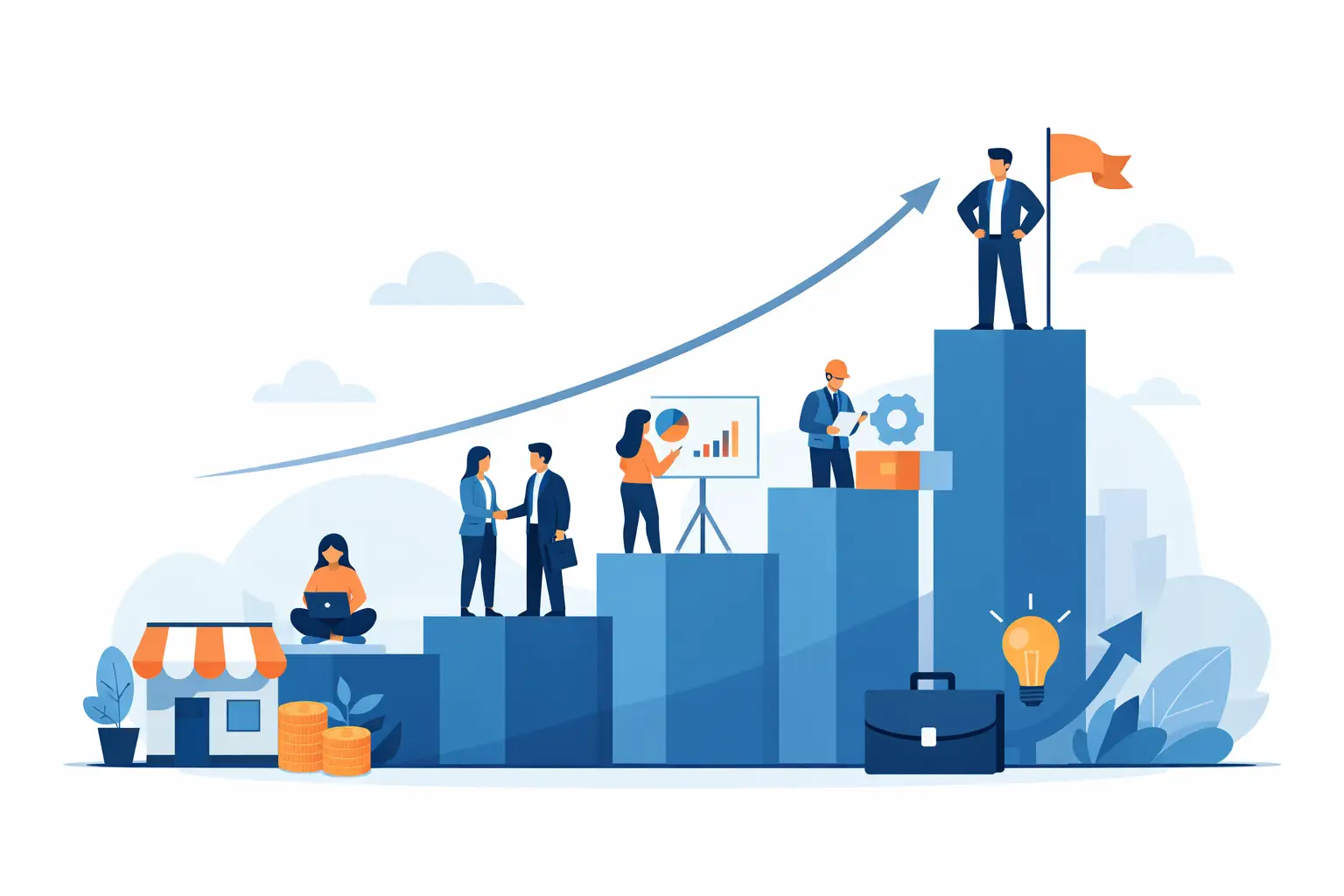
A widely used framework breaks small business growth into five stages: existence, survival, success, take-off, and resource maturity. Not every business moves through them in a clean straight line, and some stay in one stage by choice. Still, the model is useful because each stage comes with a different set of priorities, risks, and decisions.
The mistake many owners make is trying to solve a stage-three problem with stage-one tools. A business that is trying to scale cannot operate like a solo hustle forever. On the flip side, a business still proving its offer should not overbuild systems it does not need yet.
Stage 1: Existence
At the existence stage, the business is simple but fragile. The main question is whether people want what you sell and whether you can consistently deliver it. Revenue may be inconsistent. Cash flow is tight. Marketing usually depends on a few channels, personal referrals, or the owner doing everything manually.
This stage often feels personal because it is personal. The owner is usually the sales team, service team, operations manager, and bookkeeper. If that sounds familiar, you are not failing. You are in the earliest stage of proving demand.
What matters most here is clarity. You need a clear offer, a clear audience, and a clear reason someone should choose you. A basic but trustworthy website, a strong local presence, and simple follow-up processes can make a bigger difference than complex campaigns. The goal is not to look bigger than you are. The goal is to become easier to find, easier to trust, and easier to buy from.
Stage 2: Survival
In the survival stage, the business has demonstrated that customers exist and money can come in. Now the question shifts from “Can this business work?” to “Can this business support itself?”
This is where many owners start feeling stuck. The business is no longer brand new, but it is not stable enough to feel predictable. Revenue may be coming in, but margins are thin. The owner is still heavily involved in day-to-day delivery. There may be enough demand to stay busy, but not enough structure to grow with confidence.
Survival is often where founder overwhelm shows up the strongest. You are working hard, but hard work alone does not create stability. You need better visibility into your numbers, tighter operations, and more intentional marketing. Not louder marketing. Better marketing.
That usually means understanding which channels actually produce qualified leads, which services are most profitable, and where time gets wasted. For many local businesses, this is also the stage where Google Business Profile optimization, stronger reviews, clearer website messaging, and basic analytics setup start paying off. These are not flashy fixes. They are practical systems that help the business stop guessing.
Stage 3: Success
Success is where the business becomes viable enough to create choices. It is generating reliable revenue. It may have a small team. The owner is no longer asking whether the business can survive this month, but what kind of business they want to build over the next few years.
That matters because success can split into two very different paths. One business owner wants stability, healthy profit, and a manageable operation that supports their life. Another wants growth, additional locations, a larger team, or expanded service lines. Neither path is wrong, but they require different decisions.
This is also where marketing and systems need to mature together. If marketing starts working but operations cannot keep up, customer experience suffers. If operations improve but the business stays invisible online, growth stalls. Sustainable momentum comes from both sides moving in step.
At this stage, businesses benefit from more disciplined strategy. Messaging needs to reflect what makes the company credible. Reporting needs to go beyond top-line traffic and focus on lead quality, conversion trends, and return on spend. Team roles need to become clearer. Processes need to be documented. It is less about hustle and more about consistency.
Stage 4: Take-off
Take-off is where growth becomes real and risky at the same time. The business has a proven model and is trying to expand capacity, market share, or reach. Revenue may be climbing, but so is complexity.
This stage exposes weak systems fast. A founder who has always approved every detail becomes a bottleneck. A team built on goodwill and memory starts missing handoffs. Marketing spend increases, but attribution gets fuzzy. Sales grow, yet fulfillment gets strained.
In other words, growth itself can create problems if the business was not built to support it.
The central challenge in take-off is delegation backed by systems. That does not mean removing the founder from the business overnight. It means building a business that does not rely on one person to make every decision. Hiring becomes more strategic. Financial controls matter more. Dashboards, reporting rhythms, and process ownership become necessary, not optional.
This is also where many businesses need more strategic marketing support. Paid ads, SEO, local SEO, content, and social media should stop operating as separate experiments and start functioning as part of a coordinated growth plan. At Brown Business Group, this is often the point where owners benefit most from outside guidance because the stakes are higher and random tactics get expensive fast.
Stage 5: Resource maturity
Resource maturity is the stage where the business has enough structure, leadership, and financial discipline to operate with greater resilience. It has systems that can support performance over time. It is less reactive. It has better data, stronger accountability, and more capacity to adapt.
That does not mean the business is finished growing or free from risk. Mature businesses can absolutely decline if they become complacent. But the difference is that they have a stronger foundation for making decisions, managing change, and investing intentionally.
At this stage, marketing is usually more measured and integrated. The business understands its numbers, protects its brand reputation, and evaluates opportunities with more discipline. Leaders are not just asking, “How do we get more leads?” They are asking, “Which growth opportunities fit our capacity, margins, and long-term goals?”
That shift matters. Bigger is not always better. Better-managed is better.
How to tell which stage your business is in
If you are wondering what are the five stages of small business growth because your business feels messy, start by looking at a few practical signals.
Ask yourself whether demand is proven or still inconsistent. Look at whether the business can support itself financially without constant scrambling. Consider how dependent operations are on you personally. Review whether your marketing produces steady, measurable results or mostly random spikes. Notice whether your team and systems can handle more volume without service quality dropping.
Most businesses do not fit perfectly into one stage. You might have stage-three revenue with stage-two systems. You might have strong demand but weak margins. You might look mature from the outside while still relying on the owner for too many core functions. That is common.
The goal is not to label yourself. The goal is to identify the next bottleneck honestly.
Why this framework matters for marketing decisions
One reason this model is so useful is that good marketing depends on business stage. A business in existence may need credibility and visibility. A business in survival may need lead consistency and better tracking. A business in success may need stronger positioning and conversion improvements. A business in take-off may need channel coordination, reporting, and scalable systems.
That is why no-fluff strategy matters. If an agency sells the same package to every business, it is ignoring the reality that growth challenges change over time. What works for a stable company trying to scale is often the wrong solution for a founder still validating their offer.
The best next move is usually less dramatic than people expect. It may be tightening your service mix, improving your website messaging, claiming more local visibility, setting up conversion tracking, or documenting repeatable client workflows. Small changes, made at the right stage, often outperform big expensive moves made at the wrong one.
Growth gets easier to manage when you stop treating every problem like a marketing problem. Sometimes it is a positioning issue. Sometimes it is a systems issue. Sometimes it is a capacity issue. The stage helps you tell the difference.
If your business feels stretched, that does not always mean something is wrong. It may simply mean the business is asking for a new level of structure. The more clearly you can name your stage, the more confidently you can build what comes next – not with flashy promises, just steady, sustainable growth.