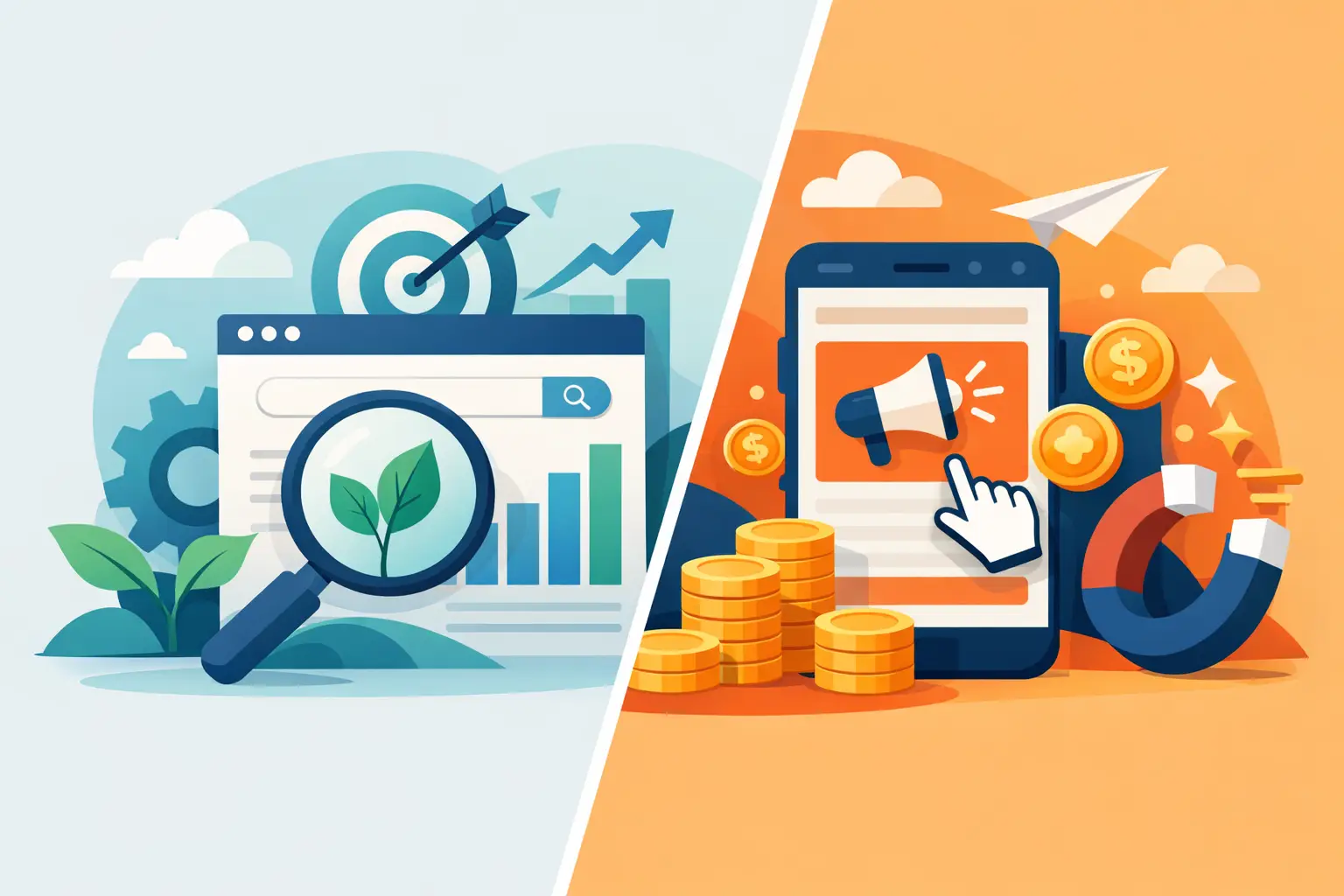
If you have ever looked at your marketing budget and thought, “I can afford traffic now or growth later, but maybe not both,” you are asking the right question. The real conversation around seo vs paid ads is not which one is universally better. It is which one fits your business model, your timeline, and your cash flow without adding more guesswork to your week.
For small business owners, this choice feels personal because the stakes are real. A few hundred dollars spent in the wrong place is not a line item you forget about. It is payroll pressure, delayed upgrades, or another month of wondering why the phone is quiet. That is why this decision deserves a clear, practical answer instead of agency hype.
SEO vs paid ads: what is the actual difference?
SEO helps your business show up in unpaid search results over time. That includes your website pages, your Google Business Profile visibility, local map presence, and the overall trust signals that help search engines understand what you do and where you serve. It usually takes longer to build, but the payoff can compound.
Paid ads put you in front of people quickly. You pay for placement, clicks, impressions, or calls depending on the platform and campaign type. Google Ads is the most obvious example for search intent, but paid social can also play a role if your audience responds well to it.
The biggest difference is not simply free traffic versus paid traffic. SEO is an asset-building strategy. Paid ads are an access strategy. One builds momentum. The other rents attention.
Neither approach is wrong. The problem starts when a business expects one to do the job of the other.
When SEO makes more sense
SEO is often the better choice when your business depends on ongoing visibility, trust, and local discovery. If people regularly search for what you do in your area, and if you want leads to continue coming in without paying for every click forever, SEO deserves serious attention.
This is especially true for service businesses with repeatable demand. Think dentists, med spas, law firms, contractors, accountants, therapists, home service providers, and local professional services. If someone types in a clear need plus a location, showing up organically matters.
SEO also works well when your website already gets some traffic but does not convert enough of it. In that case, the issue may not be visibility alone. It may be page structure, weak messaging, slow load times, poor local signals, or a lack of content that matches how customers actually search.
The trade-off is patience. SEO usually does not deliver overnight. If your site is new, your local presence is thin, or competitors have invested for years, it can take time to gain traction. That does not mean it is ineffective. It means it behaves more like building equity than flipping a switch.
When paid ads make more sense
Paid ads are useful when speed matters. If you need leads this month, are launching a new offer, entering a new market, or trying to validate demand before investing deeply in long-term optimization, ads can give you useful data fast.
They also help when search rankings are highly competitive and your business cannot wait six months to see movement. A well-run paid search campaign can put you in front of high-intent prospects almost immediately.
Paid ads can be a strong fit when you know your numbers. If you understand your cost per lead, close rate, and customer lifetime value, you can make informed decisions about how much to spend. That is where ads become a business tool instead of a gamble.
The trade-off is simple. When you stop paying, visibility stops. That does not make ads bad. It just means they require tighter tracking and stronger financial discipline.
The budget question most owners are really asking
Many small business owners frame seo vs paid ads as a question of affordability. That makes sense, but the more useful question is this: what kind of return do you need, and how quickly do you need it?
SEO usually spreads its value over time. You may invest monthly in website improvements, content, local optimization, technical cleanup, and reporting before you feel the full result. But once you gain rankings and stronger local visibility, each additional lead does not carry the same direct cost as a paid click.
Paid ads create a more immediate cost-to-result relationship. You fund the campaign, traffic arrives, and performance becomes measurable quickly. That speed is helpful, but it can also expose weak systems faster. If your website is confusing, your intake process is slow, or your offer is unclear, ads will not solve that. They will simply make the problem more expensive.
For businesses with limited budgets, this matters a lot. Spending $2,000 a month on ads with no tracking or poor follow-up is not aggressive growth. It is avoidable waste.
SEO vs paid ads for local businesses
For local businesses, the answer is often less dramatic than people expect. It is rarely all SEO or all paid ads.
Local SEO supports the foundation. Your Google Business Profile, local citations, reviews, service pages, and location relevance all influence whether nearby customers can find and trust you. If you serve a community and depend on local demand, this is not optional. It is basic infrastructure.
Paid ads can then support specific goals. Maybe you want to promote one service line, cover a seasonal slow period, or compete in a high-value category where organic visibility is still developing. In that case, ads can fill the gap while your SEO matures.
This is where many small businesses get frustrated. They are told to spend on ads before the basics are in place, or they are sold SEO with no realistic discussion of timing and competition. A grounded strategy looks at both channels in the context of your actual capacity and goals.
What each channel is best at
SEO is best at building long-term discoverability, strengthening credibility, improving local presence, and lowering dependence on constant ad spend over time. It also supports the broader customer journey because people tend to trust businesses that appear naturally in search results and have a strong online presence.
Paid ads are best at speed, testing, targeted visibility, and capturing demand in the short term. They are also useful for gathering real data. You can learn which keywords convert, which offers get attention, and which landing pages hold up under pressure.
That said, each channel has blind spots. SEO can be slow and vulnerable to weak execution. Paid ads can become costly fast if targeting, messaging, or tracking is off.
A smarter way to decide
If your business needs leads right away and has a proven service with healthy margins, paid ads may deserve a larger short-term role. If your business has been around for a while, serves a clear local market, and wants steadier lead flow with less dependence on paid traffic, SEO likely deserves more investment.
If you are early in growth, the strongest answer may be to start with the essentials in both. Build a website that clearly explains what you do, tighten your local SEO, make sure your analytics are set up correctly, and test a focused paid campaign rather than a broad one. You do not need flashy promises. You need useful data and a system you can sustain.
At Brown Business Group, this is the part that matters most: your marketing should match your operational reality. There is no benefit in generating leads you cannot respond to well, and there is no reason to keep funding traffic if your website is not earning trust.
The mistake that makes both channels underperform
The most common issue is not choosing the wrong channel. It is expecting marketing to compensate for unclear positioning, weak follow-up, or inconsistent customer experience.
If your message is vague, SEO content will struggle. If your landing page is weak, paid ads will struggle. If no one answers the phone, both will struggle.
Good marketing amplifies what is already working. It can improve weak spots, but it cannot quietly replace business fundamentals forever. Small business owners often feel pressure to pick the perfect tactic, when the better move is usually to build a clearer system around lead generation, conversion, and measurement.
That is also why transparency matters. You should know where your leads are coming from, what they cost, and what happens after they arrive. Without that, seo vs paid ads becomes a debate based on opinions instead of results.
If you are trying to choose between the two, do not ask which channel is more popular or more impressive. Ask which one helps your business become easier to find, easier to trust, and easier to grow in a steady way. That answer tends to be a lot more useful than the sales pitch.