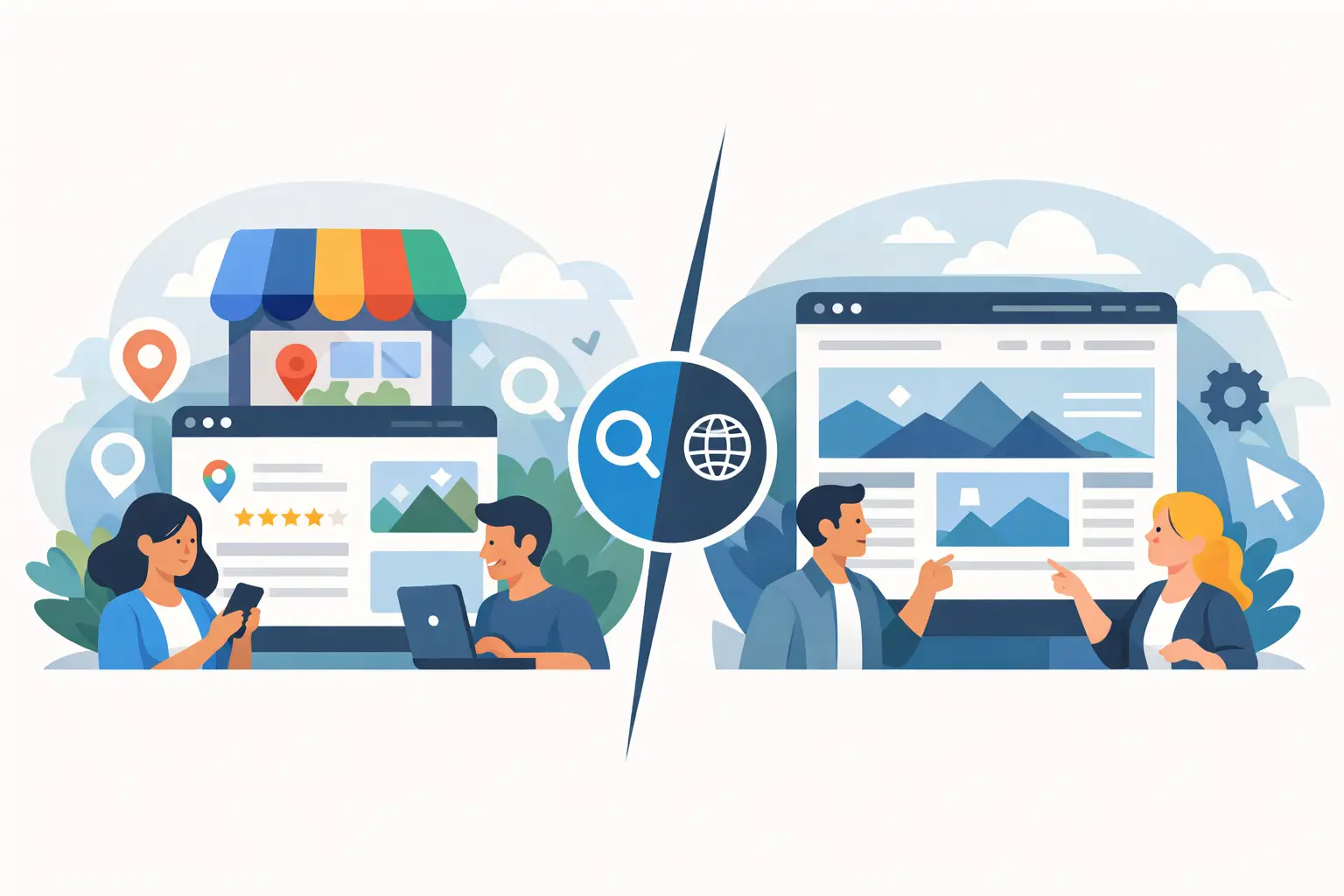
If you are trying to grow a local business on a real-world budget, the question is not just whether people can find you. It is whether they trust what they find. That is where the google business profile vs website decision gets tricky for small business owners. One helps you show up fast in local search. The other gives you control, credibility, and a place to turn attention into action.
A lot of owners feel pressured to choose one. That usually happens when time is tight, cash is tighter, and someone has said you “just need to get on Google” or “you need a website first.” The truth is less dramatic and more useful. These tools do different jobs, and knowing the difference can save you from wasting money or building the wrong thing first.
Google Business Profile vs website: they are not the same tool
A Google Business Profile is a local discovery tool. It helps your business appear in Google Maps, local search results, and branded searches. It is often the first thing someone sees when they are looking for your hours, address, reviews, phone number, or photos.
A website is your digital home base. It is where you explain what you do, who you help, how your process works, what makes you different, and what action you want a visitor to take next. Unlike your profile, your website is fully yours. You control the structure, messaging, offers, lead forms, service pages, and tracking.
That difference matters. A Google Business Profile is built for quick decisions. A website is built for deeper trust.
When a Google Business Profile matters more first
If you serve a local market and depend on calls, directions, appointments, or walk-in traffic, your profile can create immediate visibility. This is especially true for contractors, med spas, salons, attorneys, clinics, restaurants, home service businesses, and any company where proximity affects the buying decision.
Someone searching “plumber near me” or “best dog groomer in town” is often ready to act. In those moments, your Google Business Profile can do a lot of heavy lifting. It can show your reviews, answer common questions, display your service area, and give people a fast path to call.
For a newer business, that can feel like a win because it is one of the fastest ways to get visible without building a full website first. It is also free to set up, which matters when every expense has to justify itself.
But free does not mean complete. A profile is still limited space on someone else’s platform. You cannot shape the experience the same way you can on a website, and you are operating inside Google’s rules and layout.
When a website matters more first
If your sale requires explanation, comparison, education, or trust-building, a website should move up the priority list quickly. The same is true if you offer multiple services, operate in several locations, or need to communicate a more professional brand than a simple listing can support.
A website helps when customers are asking questions like these: How does this work? What does it cost? Have you done this before? Are you credible? Do you understand my situation? Can I trust you with a larger purchase?
That is where a profile starts to run out of room. You can add photos, service categories, and updates, but you cannot fully guide a buyer through your message. You also cannot build out stronger SEO content, install detailed analytics, or create a clear conversion path the way you can on a site.
For service-based businesses, that difference is often the line between getting random inquiries and getting better-fit leads.
The real answer to google business profile vs website
Most small businesses do not need to choose one forever. They need to prioritize based on their current stage.
If you have no online presence at all, start with the fastest path to being found locally and the clearest path to building trust. In practice, that usually means claiming and optimizing your Google Business Profile while also building at least a simple, credible website. Not a huge custom project. Not ten pages of filler. Just enough to show you are real, relevant, and ready to serve.
If your budget is limited, think in phases. Your profile helps people discover you. Your website helps them decide.
That sequence matters because visibility without trust creates hesitation, and trust without visibility does not generate enough opportunity.
What a Google Business Profile can do that a website cannot
A profile has one big advantage: local search placement. When someone searches with local intent, Google often shows map results before traditional website listings. That gives your business a chance to appear in a high-visibility section of the page, even if your website is still gaining traction.
It also carries social proof in a very direct way. Reviews are front and center. Prospects can scan your star rating, read customer experiences, see recent photos, and call without clicking through multiple pages.
For businesses that rely on convenience and local trust, that is powerful. A strong profile can absolutely drive calls, visits, and leads.
Still, there are trade-offs. You do not own the platform. Features change. Suspensions happen. Competitors can outrank you. And if someone wants more than the basics, your profile may not answer enough questions to move them forward.
What a website can do that a Google Business Profile cannot
A website gives you depth. You can build service pages around what customers actually search for, explain your process, share proof, answer objections, and create better calls to action. You can also connect the site to analytics and conversion tracking so you know what is working instead of guessing.
That last point is often missed. Many owners look at marketing as a visibility problem when it is really a systems problem. If people are visiting but not contacting you, the issue might be weak messaging, poor page structure, unclear offers, or a site that does not build confidence. A website lets you fix those things.
It also supports long-term growth. Your Google Business Profile helps you show up in local moments. Your website helps you rank for broader search terms, support ad campaigns, publish useful content, and create a stronger overall brand presence.
If you want your marketing to become more stable over time, your website usually becomes the foundation.
Common mistakes small businesses make
One common mistake is treating a Google Business Profile like a full marketing strategy. It is a valuable channel, but it is not enough on its own for most businesses that want consistent growth.
Another mistake is overbuilding a website before the basics are in place. A beautiful site that is not connected to local SEO, tracking, and a verified profile may look polished while still underperforming.
There is also the issue of inconsistency. If your business name, phone number, hours, or services do not match across your profile and website, trust takes a hit. Search engines notice that too.
The stronger approach is simple: align both assets, keep them current, and make sure each one supports the other.
How to prioritize if your budget is under pressure
If money is limited, do not think in terms of all or nothing. Think in terms of minimum effective presence.
Start with a verified and properly optimized Google Business Profile. Use accurate categories, complete service information, current photos, business hours, and a steady review strategy. Then build a website that covers the essentials well: who you help, what you offer, where you work, why people trust you, and how to contact you.
That setup does not have to be flashy. It does need to be clear. Small businesses often get better results from a clean, strategic foundation than from scattered spending on trendy tactics.
This is also where working with the right advisor matters. At Brown Business Group, the goal is not to push business owners into oversized marketing plans. It is to build practical systems that help them get found, earn trust, and grow steadily without adding more overwhelm.
Which one should you invest in more over time?
In the early stage, your Google Business Profile may produce faster local wins. Over time, your website usually becomes the bigger strategic asset because it supports SEO, paid traffic, content, brand positioning, and conversion improvement.
That does not mean your profile becomes less important. It means the profile often performs best as part of a larger system. Reviews, local visibility, reputation, and website experience all work together.
If you are asking which one matters more, the better question is this: where is your business losing momentum right now? If people cannot find you, fix visibility. If they find you but do not act, fix trust and conversion. That answer will tell you what to prioritize first.
The good news is you do not need a flashy marketing setup to make progress. You need a clear message, accurate local visibility, and a website that makes it easy for the right customer to say yes.